

Culture Minister has stated in Rabat that the cultural industries represent a key factor for Mauritania’s sovereignty and development
Rabat
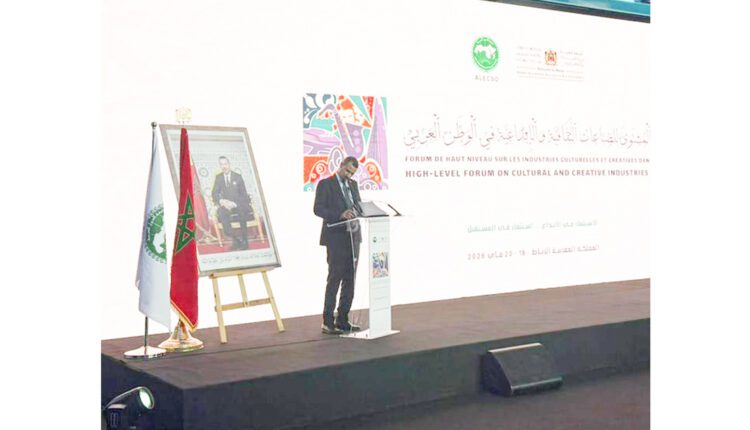
The Minister of Culture, Arts, Communication and Relations with Parliament, and Government Spokesperson, Mr. El-Hussein Ould Medou, stated that cultural and creative industries have become among the most important drivers of the global economy and strategic influence, stressing that Mauritania possesses the cultural and civilizational assets needed to establish a strong presence within this growing global trend.
During a speech delivered Monday in Rabat at a regional conference organized by ALECSO on the reality and prospects of cultural and creative industries in the Arab world, the Minister explained that global shifts in sources of power and wealth have placed culture and creativity at the forefront of the modern economy. He noted that imagination has become an economic resource, ideas an investment asset, and cultural identity a productive force capable of generating wealth, creating jobs and strengthening the symbolic influence of nations.
He emphasized that the world is rediscovering culture as a pillar of comprehensive development because of its ability to connect the economy with people, development with values, and the market with identity. He added that major economies are increasingly investing in cinema, music, digital arts, publishing, cultural tourism and digital content.
Speaking about Mauritania, the Minister highlighted the country’s exceptional cultural and civilizational heritage, shaped over centuries through knowledge, trade, travel, Sufism and cultural diversity. He referred to the historic UNESCO-listed cities of Chinguetti, Wadane, Tichitt and Walata, their ancient manuscripts and scholarly libraries, and the Chinguetti Madrasa as a unique model of learning in the Islamic world.
He also pointed to Mauritania’s rich oral heritage, including the epic of Samb Galadio, as well as its musical diversity, traditional crafts and geographical diversity, which provide strong opportunities for cultural and environmental tourism and the visual content industry.
The Minister stressed that although these assets remained outside economic valuation for decades, Mauritania has recently begun, under the vision of President Mohamed Ould Cheikh El Ghazouani, to treat culture as a strategic pillar of development. He added that the government of Prime Minister Mokhtar Ould Ajay is implementing policies linking culture with the digital economy, tourism, education, entrepreneurship and investment, while supporting artists and strengthening intellectual property protection.
He explained that the main challenge now is moving from preserving heritage to investing in it economically, and from consuming global content to producing content that reflects national identity. He noted that manuscripts could become digital platforms and research centers, historic cities could become global cultural tourism destinations, and folk tales could provide material for film and video game industries.
The Minister further emphasized that digital transformation and artificial intelligence open unprecedented opportunities for heritage protection, reproduction and global dissemination.
Concluding his remarks, he stressed that cultural and creative industries are no longer a secondary option, but a major issue of sovereignty and development that requires cooperation between the state, private sector, universities, financial institutions, creators, media and civil society.
The conference is part of ALECSO’s efforts to strengthen Arab cooperation in culture and creativity and to keep pace with global transformations linked to the cultural economy, one of the fastest-growing sectors internationally and among the most capable of creating jobs and supporting sustainable development.