

Nairobi: President of Republic Chairs High-Level Session on Sustainable Agricultural, Food Systems in Africa
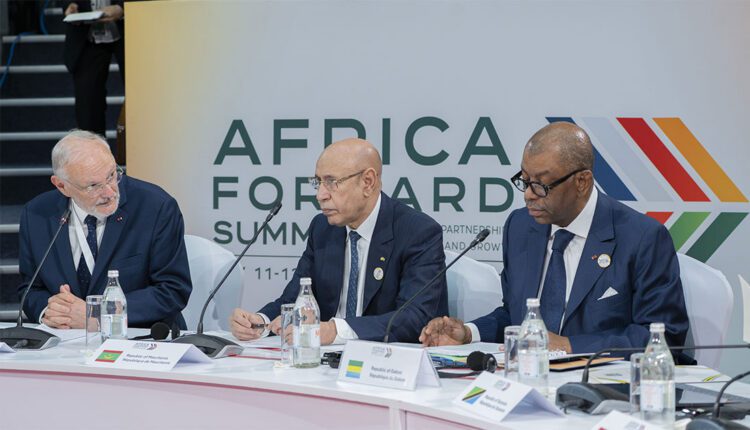
On 12 May on the sidelines of the Africa Forward Summit in the Kenyan capital, His Excellency Mr. Mohamed Ould Cheikh El Ghazouani, President of the Republic, chaired a high-level session dedicated to ways of strengthening sustainable agricultural and food systems across the African continent.
This roundtable brought together several heads of state, institutional leaders, international partners, and development stakeholders to discuss challenges related to food sovereignty, climate resilience, and the sustainable transformation of African agriculture.
In a speech delivered on the occasion, the President of the Republic stressed that although Africa possesses more than 60% of the world’s uncultivated arable land, the continent still imports nearly 115 billion dollars’ worth of food products every year.
His Excellency pointed out that this structural imbalance — characterized by the export of raw materials and the import of processed goods — constitutes a major source of economic vulnerability and a threat to the food and health security of African populations.
Below is the full text of the President’s speech:
“Thank you, Mr. Jean-Michel de Servino.
Thank you very much, Your Majesty, who has indeed outlined and presented so clearly the subject of our roundtable discussion.
As you rightly said, the theme of our roundtable concerns how to build productive, sustainable, and resilient agri-food systems in Africa, and how to strengthen partnerships toward that goal.
Although our continent possesses more than 60% of the world’s uncultivated arable land, Africa spends nearly 115 billion dollars every year importing its own food.
This structural imbalance — exporting our raw materials while importing processed products — is a major source of economic vulnerability and a risk to our food and health security.
It is therefore of paramount importance for us to transform our agricultural potential into a true driver of sovereignty.
To achieve this, we must find appropriate solutions to a number of constraints and challenges, including climatic hazards. Despite having 60% of the world’s uncultivated arable land, we are able to irrigate only 6% of it. As a result, our harvests remain dependent on increasingly unpredictable rainfall.
There is also the issue of low agricultural productivity, caused among other things by limited access to quality inputs, weak mechanization, and the lack of storage infrastructure.
Another equally important issue is the vastness of our lands, which may inspire dreams, but whose immediate usability remains very limited. These realities represent a significant number of challenges.
This roundtable therefore reflects our shared determination to make this sector a lever for development and prosperity for our populations.
This ambition is fully in line with the African Union’s vision, as embodied in the comprehensive agricultural policy framework and Agenda 2063.
Our organization continues to advocate for a radical transformation in which agriculture should no longer be merely a means of subsistence, but rather the engine of inclusive industrialization.
Furthermore, the Malabo Declaration and the recent action plan on soil fertility illustrate the African Union’s commitment to mobilizing our states to triple intra-African agricultural trade and strengthen our resilience to climate shocks.
To unlock and transform this potential into reality, we must focus our thinking on three priority challenges.
The first challenge is the mobilization of international expertise. Since we are here today with France and, through France, with Europe, we can work together — particularly in research, training, and innovation — to develop our agricultural sectors, structure value chains, and guarantee both food sovereignty and nutritional quality.
Another key area is how to attract professional private-sector operators in agriculture and mobilize the financial resources needed to support entrepreneurship in agro-processing and secure productive and sustainable agriculture.
Finally, the third aspect concerns how to harness future-oriented solutions to promote local agricultural practices and support vital initiatives such as the Great Green Wall for greater resilience.
I am therefore convinced that our discussions around this table will help further illuminate possible solutions capable of helping our continent build sustainable and resilient agriculture.
Thank you.”