

Government spokesman: Cultural Activities will be organized in all Regional Capitals, Including 40 Festivals.
Nouakchott
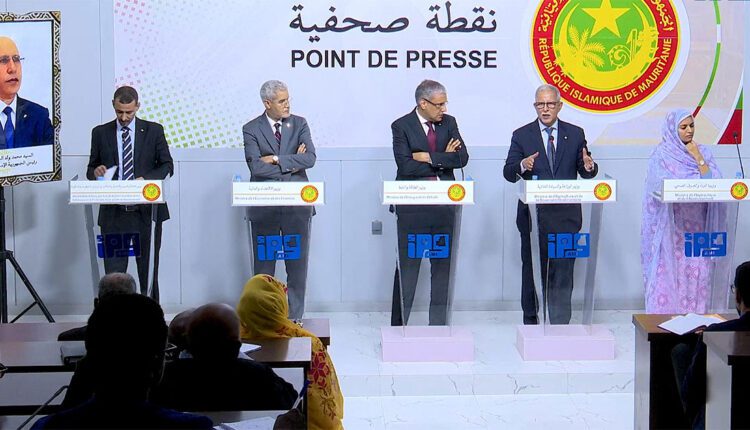
The Minister of Culture, Arts, Communication, and Parliamentary Relations, government spokesman, Mr. El -Hussein Ould Medou, stated that all Regional capitals will witness, between August 2 and September 2, 2025, the organization of many cultural and tourist activities, in addition to organizing 40 cultural festivals.
In response to a question about the topic, during his comments on the results of the Council of Ministers meeting this evening in Nouakchott alongside the Ministers of Economy and Finance, Energy and Oil, Agriculture and Food Sovereignty, and Water and Sanitation, he confirmed that organizing these cultural events is in response to the directives of His Excellency the President of the Republic, Mr. Mohamed Ould Cheikh El Ghazouani, to spend holidays domestically to discover the country’s tourist potentials and to reinforce values of communication and familial ties.
The Minister added that several government sectors have formed partnerships, such as the Ministry of Culture, Trade, Tourism, Environment, and Interior, in order to ensure the success of the tourism season that started from the city of Atar coinciding with the ‘Kaitna’ season, highlighting that the next stop will be the city of Kiffa (on the 26th and 27th of July), followed by Aioun (on August 12), and then Aleg (on the 16th and 17th of the same month).
In turn, the Minister of Economy and Finance, Mr. Sid’ Ahmed Ould Bouh, during his comments on the draft law regarding the amendment of the budget for the year 2025, confirmed that the amended budget is more effective in revenue collection (6.46 billion ouguiyas), which demonstrates the effectiveness of the tax policy, as its percentage has now exceeded 50.48% compared to 47% during the same period last year, (76 billion ouguiyas instead of 72 billion, an increase of 5%).
He added that revenues increased by 6.46 billion ouguiyas, while the expenses also increased by 2.5%, rising from 116 billion to 119 billion in the amended budget. Additionally, the operating expenses budget saw an increase, just like the investment budget, which also experienced a rise. The new budget succeeded in controlling the deficit, which reached 0.44%, in addition to achieving a decrease in the inflation rate from the 4% that was expected in the original budget to 2.5% in the current budget.
He emphasized that among the new reforms related to taxation, which have been introduced in the amended budget, is an increase in the consumption tax from 29% to 47%, and an increase of 100 Ouguiyas on every pack of cigarettes, to protect consumers’ health on one hand, and in line with the laws of West African countries. The budget also saw an increase in taxes on four other products, such as cement, construction iron, water, and milk.The honorable minister added that the salary block in the new budget saw an increase of 1 billion and 500 million Ouguiyas to accommodate new enrollments in social dimensions, such as health, education, and vocational training. The budget also introduced a special authority to combat corruption and another to regulate financial markets (Nouakchott Stock Exchange).
For his part,
the Minister of Energy and Oil, Mr. Mohamed Khaled, attributed the power outages in Nouakchott in recent weeks to several reasons, including structural issues such as the deterioration of the network, the significant horizontal expansion of the city, and consequently an overall increased demand for energy, alongside faults in the high-voltage electrical wires due to some maintenance work in Arafat, as well as those resulting from the ongoing construction works in Nouakchott.Regarding the solutions, the Minister confirmed that the sector has developed a plan for a definitive solution to the electricity problem, and work is currently underway on it. The state has allocated 50 billion ouguiya for this purpose, with 18 billion earmarked for the construction of a new electricity network, while the remainder has been allocated for building a large station on the way to Nouadhibou. However, these solutions require time, illustrating with figures the progress made in implementing the plan in various neighborhoods of the capital.
He stated that the National Electricity Company (Somelec) has undergone structural reforms recently, which enabled it to pay all fuel bills this year (which were previously paid by the state). Additionally, the company was able to pay three and a half billion ouguiyas in taxes owed this year, along with settling the issue of its temporary workers (865), thanks to the directives of His Excellency the President of the Republic.
His Excellency the Minister added that the sector has practical plans to solve the electricity problem across the entire national territory, which will allow for a doubling of the country’s electricity production in the near future, as the electricity issue is a top priority for His Excellency the President of the Republic, who is closely monitoring it. He expressed his regret over the inconvenience caused to citizens by the power outages in the past weeks in Nouakchott.
For his part, the Minister of Agriculture and Food Sovereignty, Mr. Momma Babetta, commented on the statement regarding the agricultural campaign for the years 2025-2026, that the sector has set an ambitious plan to make this campaign successful, which aims to produce 550,000 tons of rice (achieving an increase in self-sufficiency), and 240,000 tons of vegetables, which will cover 56% of the country’s need for this material. As for rain-fed agriculture, he stated that the campaign aims to produce 180,000 tons of grains (achieving self-sufficiency in this field).
He confirmed that the state has taken a number of measures to achieve these goals, such as introducing agricultural mechanization in this campaign, reclaiming land, providing water, training farmers, communicating with them, providing agricultural inputs, increasing dams, and maintaining them, emphasizing the existence of major projects in the agricultural sector parallel to the agricultural campaign, from which the country will benefit in the future.
The Minister clarified that the previous campaign achieved good results, both in rain-fed agriculture and irrigated agriculture, as well as in vegetable cultivation. The campaign managed to achieve self-sufficiency in rice, producing 135,000 tons of grains and 134,000 tons of various types of vegetables, which allowed for self-sufficiency in some, despite the shortfall in others.
As for the Minister of Water and Sanitation, Ms. Amal Mint Maouloud, she stated during her comments on the disturbances occurring in drinking water in the capital that the sector will work in the coming stages to maximize production from Lake Idini to reach 100,000 in the next year, and that production will double in the coastal Aftout. She added that the ministry is working on a fair distribution of water in Nouakchott based on sound principles, where work has started in northern Nouakchott, although it requires time. She affirmed that the sector has made tremendous efforts in distributing the available water in the capital, resulting in positive outcomes by reaching areas that had not previously received water.
It was confirmed that work is progressing rapidly in Nouadhibou, through the seawater desalination project and the Boulenwar Lake, as the latter will be exploited in the near future, alongside many important projects in this field, such as the Azhor project, the Kiffa Kri project, and the Bouki Al-Ghayra project, in addition to the project to supply 28 cities with drinking water (the cities were chosen objectively).
The Minister praised the structural improvement witnessed by both urban and rural water companies, in terms of both maintenance and intervention, which allowed them to operate throughout the national territory, digging more than 900 water points. Currently, they have 14 drilling workshops as part of the participatory approach established by the government within the emergency program for the development of the interior regions.